How to Build a Repeatable Sales Process for Owner-Led Firms
In most owner-led firms, the sales process lives in the founder's head and disappears the moment they get busy. Here is how to build a repeatable sales process anyone on the team can run the same way every time.
 By Kevin Durkin, Co-Founder, Strategy & AI Quant-Tek.AI
 In most owner-led firms, the sales process is not written down anywhere. It lives in the founder's head, gets applied a little differently on every deal, and disappears the moment the owner is busy or out of the office. That works until it does not. When growth depends on one person remembering to do the right thing at the right time, the pipeline becomes impossible to forecast and even harder to hand off. A repeatable sales process fixes that by turning how you sell into a set of clear, teachable steps anyone on your team can run the same way every time.
What a repeatable sales process actually is
A repeatable sales process is the documented sequence a lead moves through from first contact to a closed deal, with a defined action and a clear exit point at each stage. It is not a rigid script that makes your team sound like robots. It is a shared map of what good selling looks like in your firm: who you are trying to reach, what has to be true before a deal advances, and what happens next. When the process is written down and followed, results stop depending on who happened to handle the lead and start depending on the system itself.
Why owner-led firms never write it down
Skipping the documentation is rarely laziness. It is what happens when the person who sells best is also the person with the least time. The reasons are structural, not motivational:
- The founder already knows how to sell, so writing it down feels like busywork instead of the thing that finally lets someone else do it too.
- Every deal feels unique, so the team treats selling as improvisation rather than a sequence that can be repeated and improved.
- There is no shared definition of a qualified lead, so each person advances deals on gut feel and the pipeline fills with buyers who will never close.
- Nobody owns the process itself. Reps chase deals, the owner closes the big ones, and the system that should connect them never gets built.
How to build a repeatable sales process
You do not need a large team or new software to build this. You need to make the steps you already run explicit, then commit to running them the same way. Here is a practical version any owner-led firm can put in place this quarter.
- 1
Define who the process is for
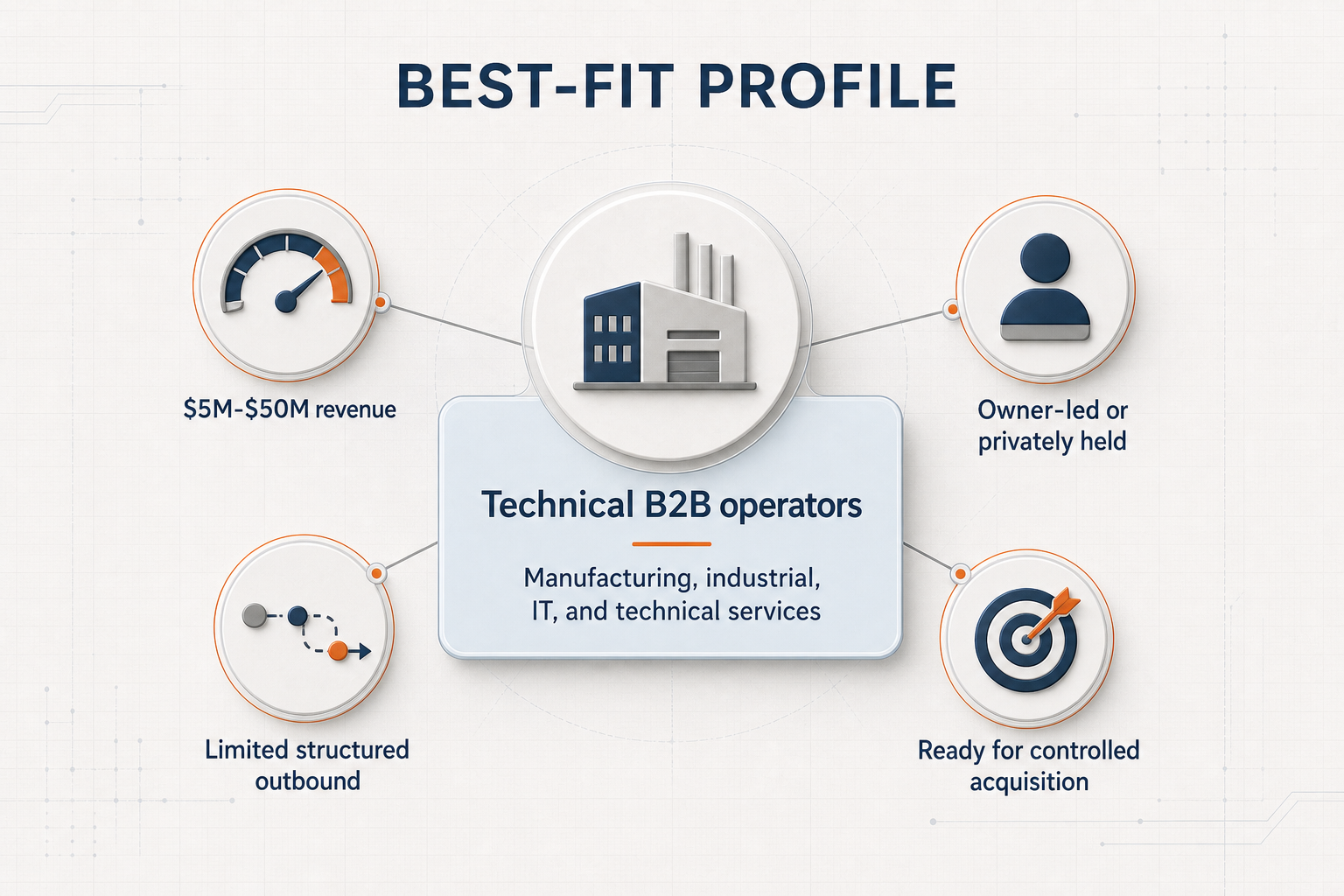
Start by naming your best-fit buyer: the industry, size, and situation where you win most often and deliver the most value. A repeatable sales process built for the wrong buyer just repeats the wrong outcome faster. Write the profile down so everyone qualifies against the same standard.
- 2
Map the stages from first contact to close
List the real stages a deal moves through in your firm, from first conversation to signed agreement. Keep it to four or five stages, each with a plain-language name. This map is the backbone of the process, and it turns a vague 'how is that deal going' into a specific 'which stage is it in and what has to happen next.'
- 3
Set an exit rule for each stage
Decide what has to be true before a deal moves forward: budget confirmed, decision-maker identified, a real problem the buyer wants solved now. These gates keep unqualified deals from clogging the pipeline and give your forecast something honest to stand on.
- 4
Standardize the follow-up between stages
Most deals stall in the gaps between stages, not inside them. Decide the default next touch for each stage: who owns it, when it happens, and what it says. A follow-up that is scheduled and specific gets done. One that depends on memory does not.
- 5
Track results and refine one thing at a time
Once the process runs, watch where deals stall or fall out. That single stage is where your next improvement lives. The process is not a document you finish once; it is a system you tighten as you learn what actually moves your buyers.
How the process connects to your pipeline
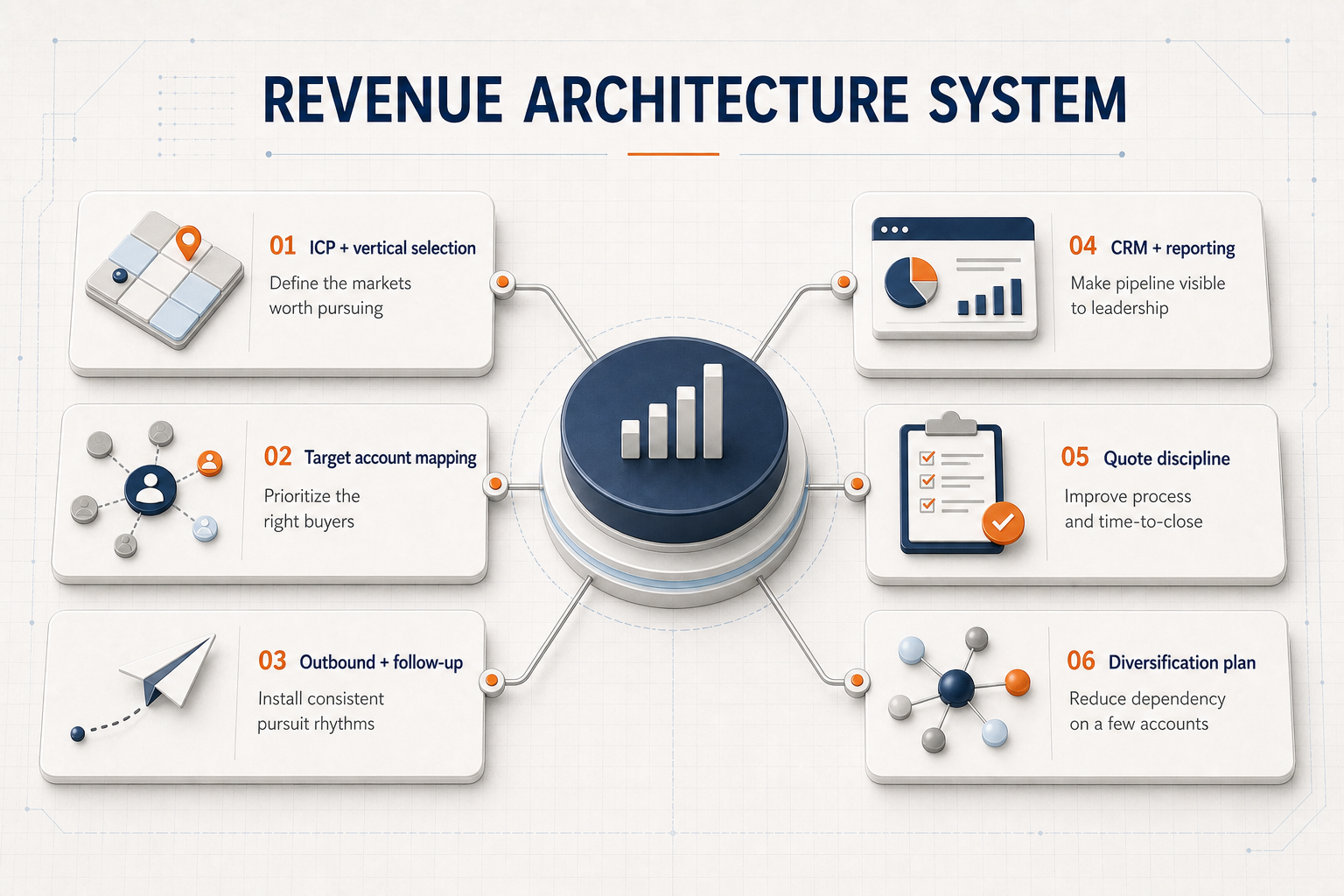
A repeatable sales process is the engine underneath a predictable sales pipeline. The pipeline is the view of deals in flight; the process is the set of steps that keeps them moving. The two reinforce each other. When you qualify every lead against the same standard and nurture the good-fit buyers who are not ready yet, each stage of the process feeds the next cleanly. All of it is a field version of the Revenue Architecture System we install for clients, which exists to make revenue a function of structure rather than heroics.
Where to start
You can begin this week without buying anything. Take your last ten closed deals and write down, honestly, the steps each one actually moved through. The pattern that shows up is the first draft of your repeatable sales process. Name the stages, set an exit rule for each, and decide who owns the follow-up between them. That one afternoon of writing turns selling from something only you can do into something your firm can run, and you can read more about how we work before you ever talk to us.