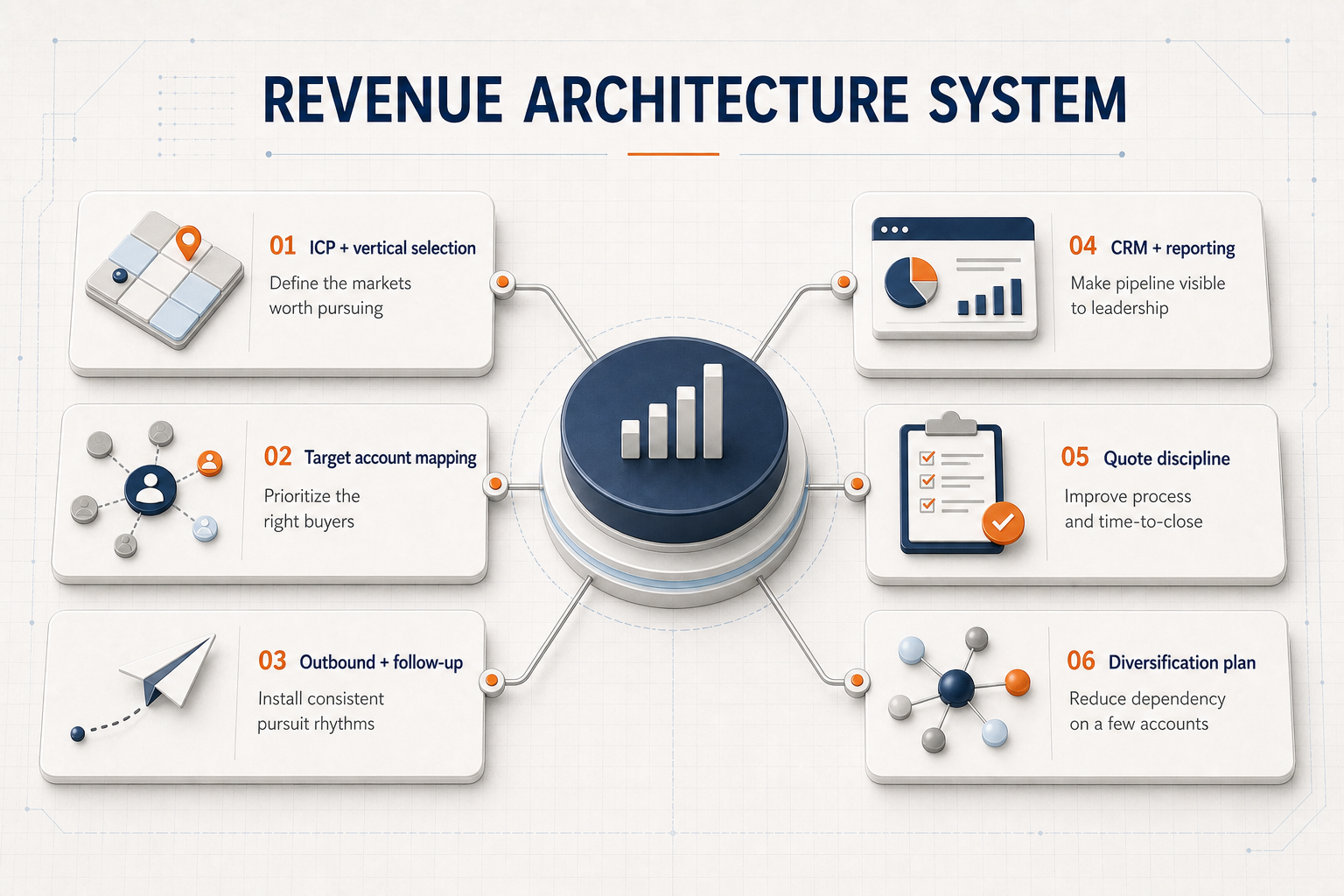
The Revenue Architecture System: How Owner-Led B2B Firms Install Predictable Pipeline
Most owner-led B2B firms do not have a sales problem. They have a structure problem. Here is the four-phase system we install to close revenue leakage for good.
 By Kevin Durkin, Co-Founder, Strategy & AI Quant-Tek.AI
 Most owner-led B2B companies do not have a sales problem. They have a structure problem. Revenue leaks out in the quiet gap between a buyer getting interested and a buyer raising a hand, and because nobody names that gap, nobody closes it. The Revenue Architecture System is the engine we design and install to close it.
What revenue leakage actually is
Revenue leakage is the predictable, compounding loss of deals you never knew were in play. It is not lost because your team is bad at selling. It is lost earlier, before the conversation starts, when a buyer researches the market, builds a shortlist, and never puts you on it. By the time the phone rings, the decision is mostly made.
The three places revenue leaks
Across the owner-led firms we work with, the leak almost always shows up in the same three layers. Fix them out of order and nothing compounds.
1. Visibility
You cannot see who is researching you. By the time a buyer calls, the shortlist is drawn and you are either on it or you are not.
2. Presence
You do not show up in the places buyers actually evaluate vendors. They check ten sources. You appear in two.
3. Trust
There is not enough independent reinforcement out there to make choosing you feel safe. Buyers want to pick you. They need a reason they can defend internally.
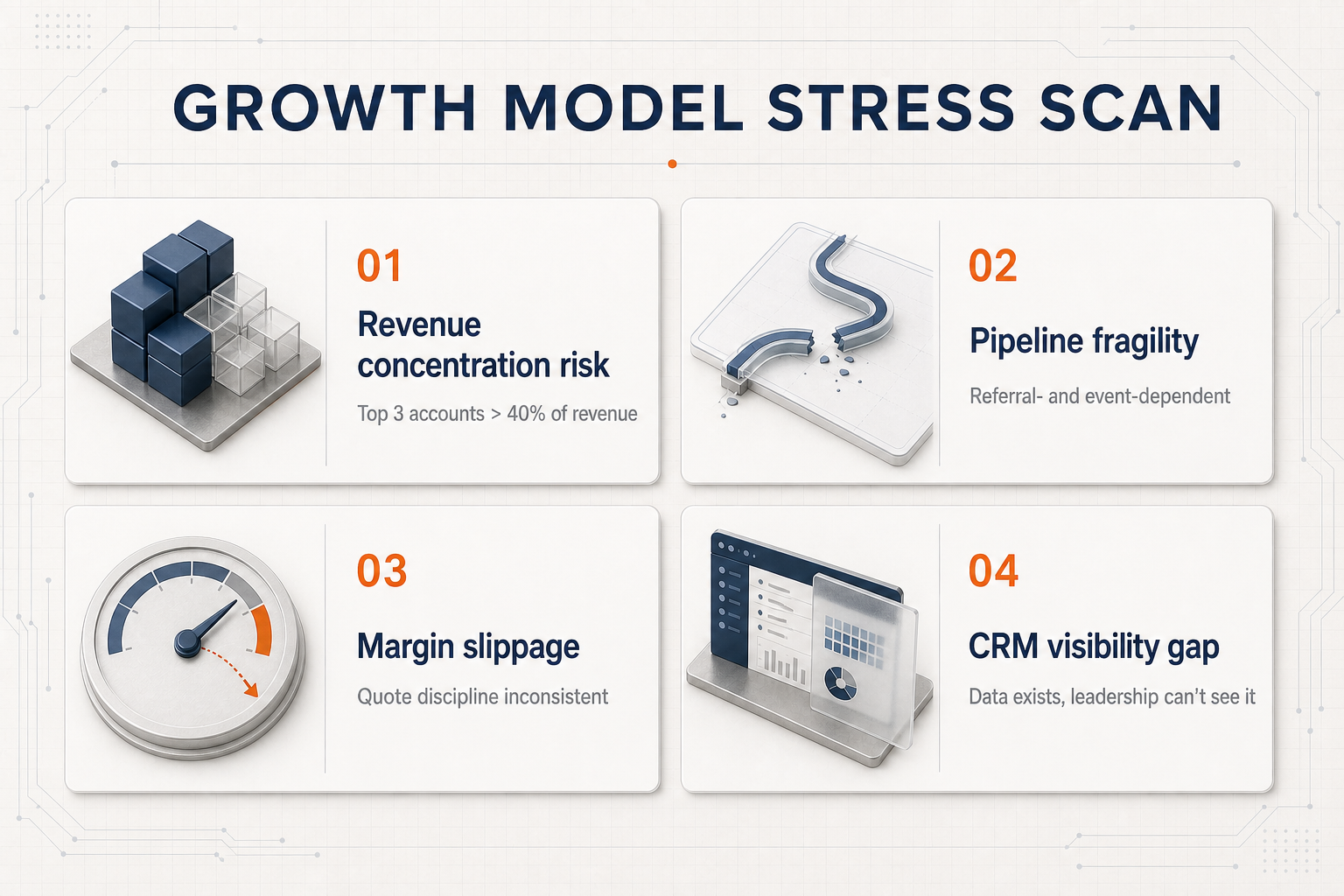
The Revenue Architecture System: four phases
We do not sell tactics. We design and install one system, in a fixed order, live in about two weeks. You can see the full engagement on our services page.
- Diagnose. We map where revenue is leaking today and why, and hand you a written diagnostic you keep whether or not we build the rest.
- Design. We lay out the engine end to end before touching anything, so you approve the structure before it goes in.
- Install. We put the engine inside your business, not on top of it, so your team owns the operating rhythm.
- Compound. From month three, visibility and authority stack, and qualified conversations start landing consistently.
Who this works for
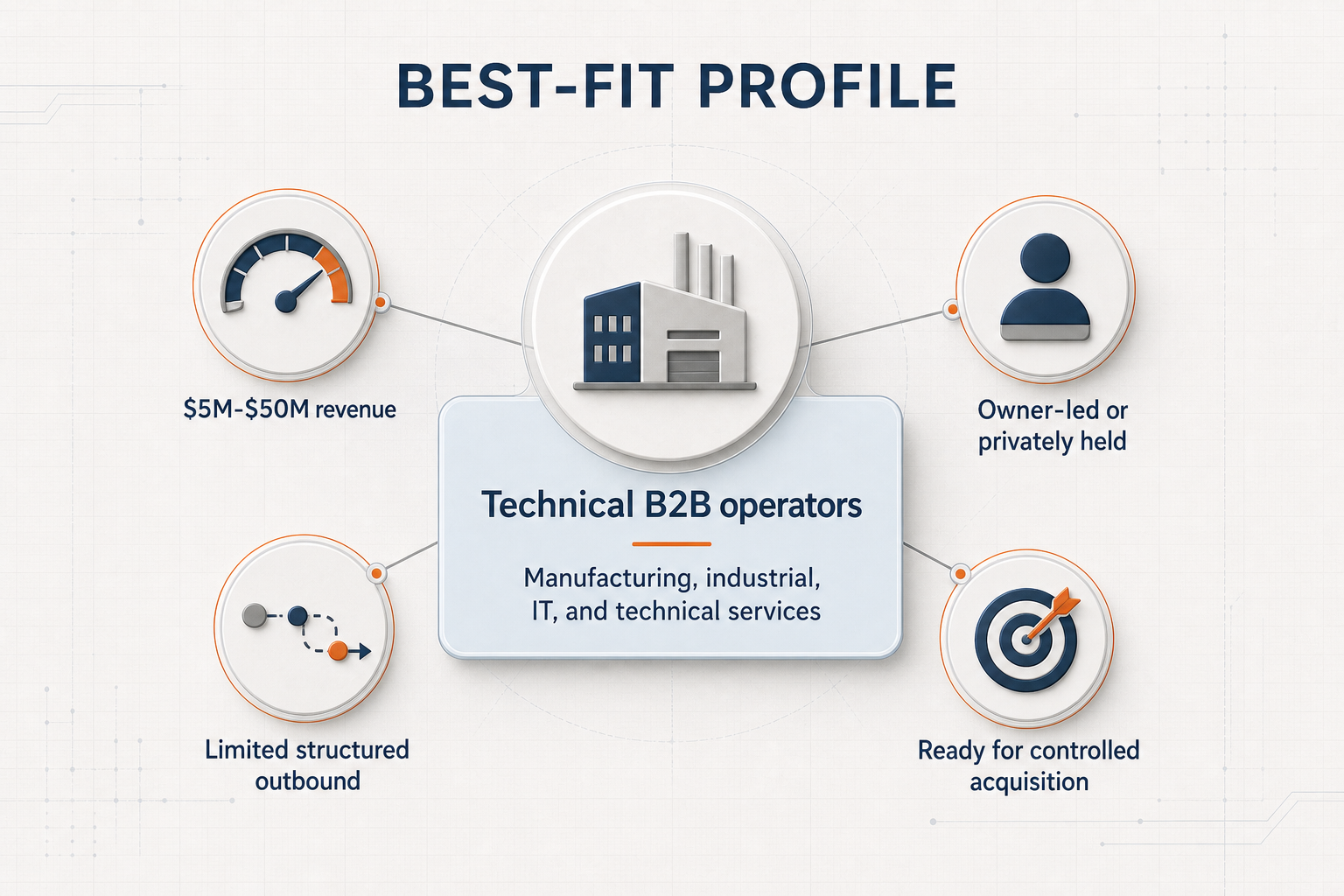
The Revenue Architecture System is built for a specific kind of company. If this is you, the leak is usually large and very fixable.
- Owner-led or founder-led B2B firms doing $5M to $50M in annual revenue.
- Manufacturing, industrial, and technical services companies.
- Operationally strong teams that are still growing reactively, deal to deal.
- Leaders who want pipeline they can trust, not another dashboard of vanity metrics.
How to spot revenue leakage in your business
You do not need us to run a first pass. Here is a short self-audit any owner can run this week.
- 1
Pull your last 20 closed deals
List how each one actually started. If most trace back to referrals or existing relationships, your top-of-funnel visibility is thin.
- 2
Search the way a buyer would
Run the three or four searches a serious buyer runs before they call. Note every place a competitor appears and you do not.
- 3
Count your independent proof
Tally the third-party signals a buyer can find without your help: reviews, mentions, case evidence, and presence where they already research.
- 4
Map the gap
Wherever a buyer could have found you and did not, that is the leak. The wider the gap, the more revenue is quietly walking past you.
Where to start
Naming the problem is the first move. The second is a 20-minute revenue audit, where we look at your pipeline together and tell you, plainly, where it is leaking. No deck, no pitch. You can also read more about how we work before you ever talk to us.

